

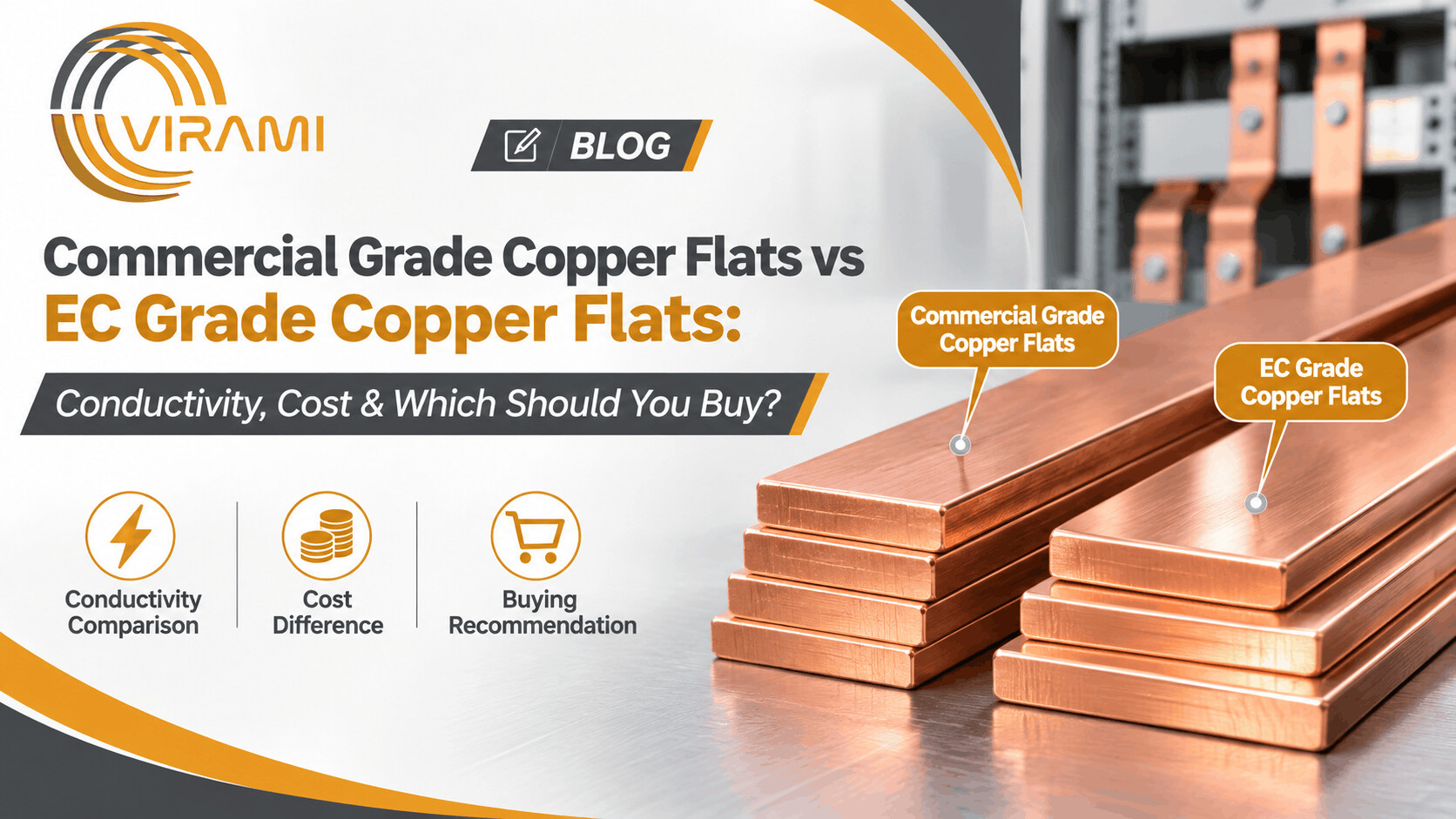
Choosing between Commercial Grade Copper Flats and EC Grade Copper Flats requires comparing conductivity, specifications, applications, and overall cost—not just price per kilogram. The wrong choice can cause extra testing, redesign, energy losses, or rejected components.
"Commercial grade copper" is a broad trade description, not one universal chemical-composition or conductivity designation. Depending on the supplier, it may describe general-purpose copper flats, material produced using recycled feedstock, or copper supplied without a guaranteed electrical conductivity rating.
Commercial-grade copper flats are not automatically unsuitable for electrical service. Request the alloy designation, copper content, temper, conductivity test results, and product standard to verify that they meet the application's requirements.
EC stands for electrical conductivity or electrical conductor grade in common trade usage. EC copper flats are intended for applications where low electrical resistance is important. A common material is electrolytic tough pitch copper, or ETP, designated UNS C11000.
C11000 generally contains at least 99.90% copper, including silver, and has a minimum conductivity of 100% IACS in the annealed condition under the relevant specification. IACS refers to the International Annealed Copper Standard, a reference used to express the conductivity of metals.
Other high-conductivity copper grades also exist, so "EC grade" alone is not a complete purchasing specification. State the required designation, conductivity, temper, and test conditions on the purchase order.
| Buying Factor | Commercial Grade Copper Flats | EC Grade Copper Flats |
|---|---|---|
| Grade definition | Varies with supplier and specification | Usually tied to a stated high-conductivity copper designation |
| Conductivity | Must be tested or documented | Specified and verifiable |
| Copper content | Depends on actual alloy | C11000 typically 99.90% minimum, including silver |
| Common selection reason | General fabrication or cost-focused use | Electrical efficiency and predictable performance |
| Initial price | May be lower, depending on material and quote | May carry a premium for controlled properties |
| Documentation | Must be requested explicitly | Request grade and conductivity certificates |
| Best purchase decision | When measured properties meet the duty | When high conductivity is an essential requirement |
Conductivity determines how readily current flows through the copper. Higher conductivity means lower electrical resistance for the same dimensions, temperature, and length. Lower resistance can reduce power losses and heat generation in current-carrying components.
For EC-grade C11000 in the annealed condition, 100% IACS corresponds to approximately 58 megasiemens per metre at 20°C. Cold working and temperature can change measured conductivity, which is why certificates and test conditions matter.
Appearance, colour, and claimed purity cannot confirm a commercial copper flat's IACS rating. Request verified conductivity results before using it in current-carrying components.
EC grade copper flats are commonly considered for switchgear busbars, electrical distribution panels, transformer connections, electrical terminals, and other applications designed around low-resistance conductors. The final section must still be sized for permissible temperature rise, fault duty, joints, and applicable electrical standards.
Commercial grade copper flats may suit non-critical brackets, general manufacturing components, decorative fabrications, or other applications where an approved specification does not require a guaranteed electrical conductivity level.
Earthing and lightning-protection systems deserve particular care. Do not choose commercial copper merely because it is cheaper: applicable standards may impose conductivity, dimensions, corrosion, and fault-current requirements. Use the material approved by the project engineer.
Purity does not equal conductivity. Impurities and mechanical processing influence resistivity, so a supplier's claim of "pure copper" is insufficient. Compare materials using a documented alloy designation and conductivity measurement.
For electrical work, request a conductivity value stated as % IACS or an equivalent resistivity measurement with its test temperature. For forming and fabrication, request the temper as well: annealed material generally bends more easily than harder cold-worked material.
Where high-temperature joining in reducing atmospheres is required, discuss the procedure with the engineer, because oxygen-bearing ETP copper has application limitations.
Commercial grade copper flats may be quoted at a lower rate than certified EC-grade material, but that price gap is neither fixed nor guaranteed. Actual prices fluctuate with copper markets, grade, dimensions, quantity, processing, and supplier terms.
Compare quotations using identical sizes and delivered quantities. Include testing, cutting, finishing, freight, taxes, and the expected cost of rejects or additional inspection.
Unverified conductivity can increase electrical design or inspection costs, while certified EC copper may offer little additional value in mechanical applications without electrical-performance requirements.
Copper flats are often sold by weight. Before requesting a quotation, estimate the theoretical kilograms using the nominal copper density of approximately 8.96 g/cm³:
Weight (kg/m) = Width (mm) × Thickness (mm) × 0.00896
A 50 × 6 mm copper flat weighs approximately 2.688 kg per metre. Six metres weigh about 16.13 kg, excluding dimensional variation.
Estimated material value = Ordered kilograms × Quoted price per kilogram.
For multiple cut lengths, work from the purchased stock length rather than just the finished total. Allow for saw kerf, unusable remnants, minimum order quantities, and any processing charges. Confirm the invoicing weight with the supplier; actual and theoretical weights may differ.
Specify copper flat width, thickness, length, edge condition, straightness, and drawing tolerances; conductivity alone does not ensure suitability.
Temper matters during bending, punching, and machining. An annealed flat may be easier to form, while harder temper can be selected when stiffness and handling characteristics are relevant. For electrical contact surfaces, review flatness, cleanliness, coating requirements, and joint preparation.
Copper surfaces naturally discolor over time; visual brightness is not proof of grade or electrical performance. If tin plating, drilling, or cut-to-length processing is needed, request these operations in the original quotation.
For conductor bars and general-purpose copper bars, ASTM B187/B187M is one relevant specification; the actual product form and project may require another standard. Avoid specifying a standard without confirming that it covers the ordered item.
A procurement enquiry should clearly identify:
For critical electrical assemblies, buyers may also request independent verification of material conductivity and relevant inspection records.
Choose EC-grade copper flats when documented conductivity is necessary for busbars, distribution equipment, or engineered grounding components. It provides a clearer basis for electrical design and incoming inspection.
Consider commercial-grade copper flats when the application is non-critical electrically and the actual material properties meet the mechanical, thermal, corrosion, and fabrication requirements. Do not use the trade description as a substitute for approval.
For industrial projects, compare certified properties and delivered quotations against the intended duty and specification.
For Commercial Grade Copper Flats, contact Virami Steel with your required material grade, application, dimensions, quantity, conductivity, and testing needs. Request availability, material certificates, finishing options, and a quotation. Confirm the offered grade and electrical properties before ordering.
Not necessarily. Commercial grade is a broad market description, while EC grade normally specifies high electrical conductivity. The actual copper grade and test certificate determine whether they are equivalent for a particular application.
ETP C11000 is commonly specified at a minimum of 100% IACS in the annealed condition. Check the supplied material's actual grade, temper, and conductivity documentation.
Only if they meet the applicable design and material requirements. Never assume an untested commercial-grade flat is suitable for a safety-critical earthing system.
Not always. Pricing depends on market conditions, size, quantity, finish, certification, and availability. Obtain comparable current quotations instead of relying on generic price claims.
Provide grade, dimensions, length, quantity, end use, required conductivity, temper, standards, documentation, processing, and delivery destination.
The best copper flat is not simply the least expensive or the one marketed with the highest purity. EC-grade copper flats are the sensible starting point where certified conductivity is essential, while commercial-grade copper flats can offer value when their verified properties match a non-critical application.
Compare the complete technical specification, processing needs, and delivered cost before buying. For reliable procurement, request written confirmation of grade and test results with every performance-sensitive order.
