

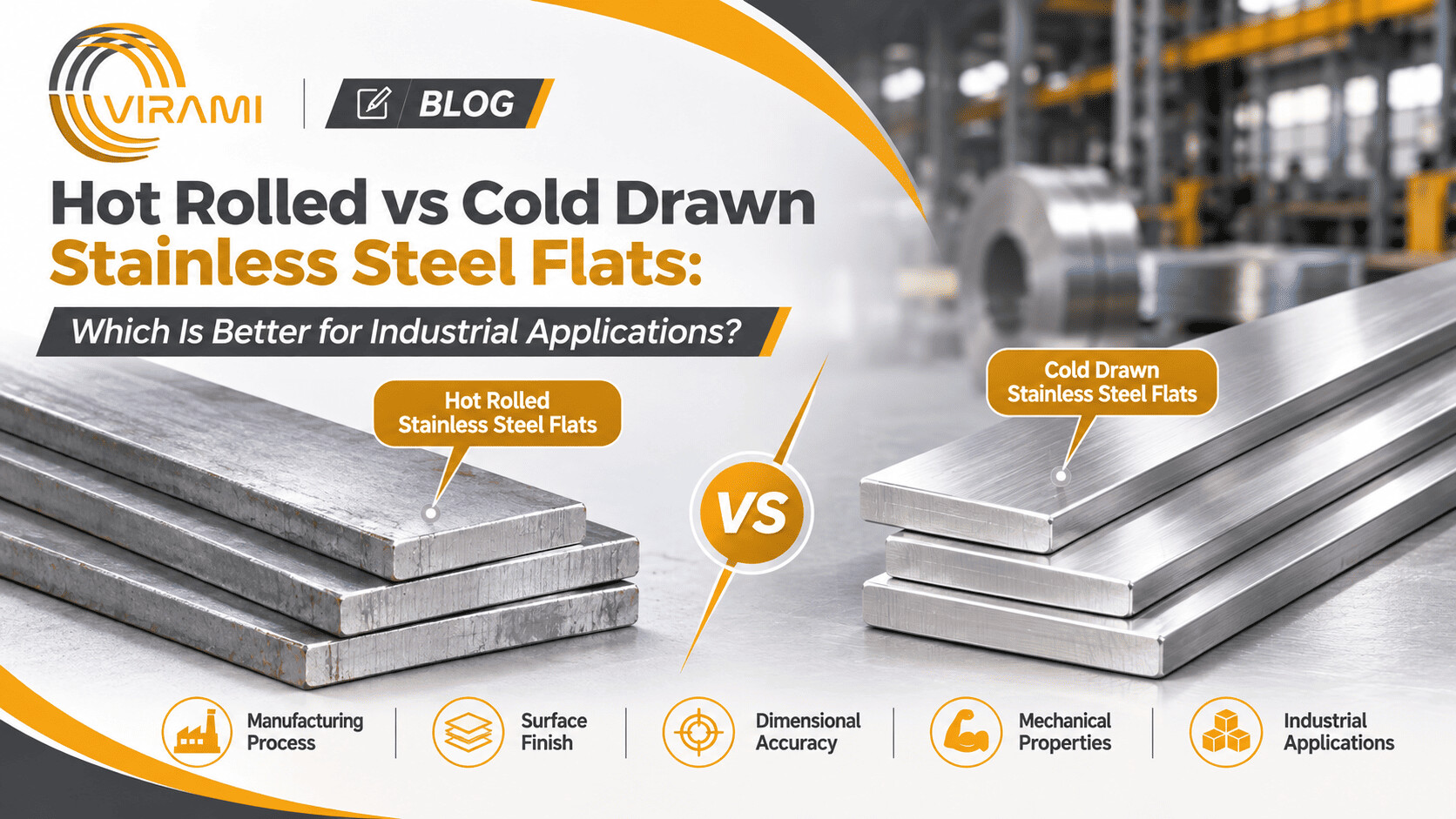
Choosing stainless steel flats is not simply a matter of selecting the correct grade and dimensions. The manufacturing process also affects how a flat bar performs during cutting, welding, machining and installation. Two common supply conditions are hot rolled and cold drawn. Although both can be suitable for industrial work, they differ in dimensional accuracy, surface condition, strength and overall purchasing cost.
The right option meets the component's requirements without unnecessary processing expense. Here's how to compare both options.
Hot rolled stainless steel flats are rectangular bars formed by passing heated steel through rolling equipment. At elevated temperatures, the material can be shaped into sections suitable for structural fabrication and general engineering work. Following rolling, bars may be annealed, straightened, pickled or otherwise descaled, depending on the specified condition.
Hot rolling is particularly practical when a project requires substantial sections, subsequent welding or machining, or a surface that will be finished later. The as-rolled surface is generally less uniform than a cold-drawn finish, and the supplied dimensions typically allow wider manufacturing tolerances.
Hot rolled flats can meet demanding specifications without the added cost of unnecessary precision finishing.
Cold drawn Stainless Steel Flats usually begin as hot-finished material. After surface preparation, the bars are drawn through a die at or near room temperature to obtain a more controlled cross-section. This additional operation generally improves dimensional consistency and produces a smoother, brighter surface.
Drawing also introduces plastic deformation, which can increase strength and hardness in some grades and conditions. However, it may leave residual stresses. A cold-drawn bar can therefore distort when heavily machined on one side unless its processing condition and machining plan are suitable.
'Cold finished' also includes processes other than drawing, such as cold rolling, grinding or polishing. Confirm the production method rather than assuming every bright bar is drawn.
| Selection Factor | Hot Rolled Flats | Cold Drawn Flats |
|---|---|---|
| Manufacturing | Shaped at high temperature | Further reduced through dies at room temperature |
| Dimensional tolerance | Generally wider | Generally closer |
| Surface appearance | Mill or descaled finish | Smoother, often brighter finish |
| Mechanical condition | Depends on grade and heat treatment | May have higher strength from cold work |
| Fabrication | Practical for welded structures and general machining | Useful where consistent section size matters |
| Cost | Usually lower initial processing cost | Usually higher initial processing cost |
| Buying priority | Section size and fabrication suitability | Accuracy, appearance and reduced finishing work |
Actual tolerances and properties depend on grade, dimensions, finishing route and standard.
Precision becomes commercially important when stainless steel flats must fit into slots, guides, assemblies or automated production equipment. Cold drawing can reduce variations in width and thickness, making repeatable fit-up easier and potentially reducing milling or grinding time.
For brackets, frames and base supports that will be cut and welded on site, the tighter as-supplied dimensions may deliver little benefit. Hot rolled flats are often sufficient if the drawing permits their tolerances.
Specify width, thickness, length, straightness and edge requirements—not just nominal size.
Cold drawn flats generally offer a neater surface suitable for visible components or parts requiring limited additional finishing. Hot rolled products can arrive descaled or pickled, but may still have a comparatively rough appearance.
Surface condition matters for cleaning and long-term service, especially in food-processing or chemical environments. Yet a brighter finish does not automatically mean better corrosion resistance. Alloy selection, contamination control, surface treatment and exposure conditions remain critical. For demanding hygiene requirements, a specified polished fiinish and surface roughness may be necessary regardless of the original rolling route.
Cold working may improve yield strength and hardness, but the amount varies with grade and reduction. It should never be assumed that every cold-drawn stainless steel flat is stronger than every hot rolled equivalent. Review the specified material condition and mill test results.
For extensive welding or forming, annealed hot rolled material can be a practical starting point because fabrication plans may prioritize ductility over additional cold-work strength. Cold-drawn flats can be advantageous for repeatable machining, though residual stress may cause movement after substantial material removal.
Choose welding procedures and post-fabrication treatments for the grade and service conditions.
A lower quotation price does not always produce the cheapest finished component. Hot rolled flats can offer savings on raw material, but additional milling, straightening or polishing may increase labour, tool use and material wastage.
Cold drawn flats have an added processing cost, yet their dimensional consistency may shorten setup time and reduce rework for precision components. Compare delivered cost, machining hours, inspection, rejection risk and lead time.
For example, a welded equipment support may favour hot rolled material, while a batch of closely fitted machine guides could justify cold drawn stock. Evaluate the finished-part cost rather than the price per kilogram alone.
Construction and structural fabrication: Hot rolled flats are often appropriate for supports, frames, reinforcement details and welded brackets where tolerances permit. Confirm the required structural design and grade.
Machinery and equipment manufacturing: Cold drawn flats can be attractive for guides, spacers and repetitive components requiring consistent profiles. For major machining, review stress-related distortion risks.
Food and pharmaceutical processing: The correct stainless steel grade and hygienic surface finish are more important than the hot-rolled or cold-drawn label. Specify cleanability, weld finishing and surface quality.
Chemical processing and marine environments: Select grades according to chemicals, chlorides, temperature and exposure. Stainless steel 316 or 316L may be appropriate in some more aggressive environments, but neither grade is universally immune to corrosion.
General fabrication and maintenance: Hot rolled flats may be the economical choice for replacement parts, mounting plates and plant structures that do not demand close dimensional control.
The distinction between production routes should be considered alongside the actual alloy. Stainless steel 304 and 304L are common choices for general corrosion-resistant fabrication. Grades 316 and 316L contain molybdenum and may offer improved resistance to certain chloride-containing environments. Higher-temperature or specialized service can require other grades and careful engineering review.
Before ordering, share these details with your supplier:
For purchasers comparing Stainless Steel Flats, a detailed enquiry helps establish which grades, dimensions and finishes are suitable and available for the project.
Industrial buyers benefit from a supplier who understands that an accurate quotation requires more than a grade name. Section size, processing condition, end-use requirements and documentation can all affect suitability and final cost.
When discussing requirements with Virami Steel, provide the component drawing or dimensional schedule and describe the intended application. Ask for confirmation of the requested grade, finish, tolerance, test documentation and supply availability before finalizing the purchase. This helps reduce specification errors and delays.
No. Cold drawn flats are useful when dimensional consistency and surface quality matter. Hot rolled flats are often more economical for welded structures and general fabrication. The application determines the better choice.
Not automatically. Corrosion resistance primarily depends on the alloy, environment and surface condition. Correct cleaning, finishing and fabrication practices are important for either product.
Yes. Hot rolled flats can be cut, drilled and machined, provided sufficient machining allowance is available and the material grade suits the operation.
Specify grade, width, thickness, length, finish, tolerance, quantity, application and delivery location. Mention certificate requirements and whether cutting or other processing is needed.
Hot rolled stainless steel flats are often a cost-effective solution for structural work, general fabrication and components that will be processed further. Cold drawn flats may justify their higher initial price where consistent dimensions, appearance and reduced finishing time matter.
Neither is the universal winner. Match the manufacturing condition to your drawing, corrosion environment, fabrication method and budget. A clear technical enquiry is the simplest route to selecting stainless steel flats that perform as intended without unnecessary purchasing costs.
