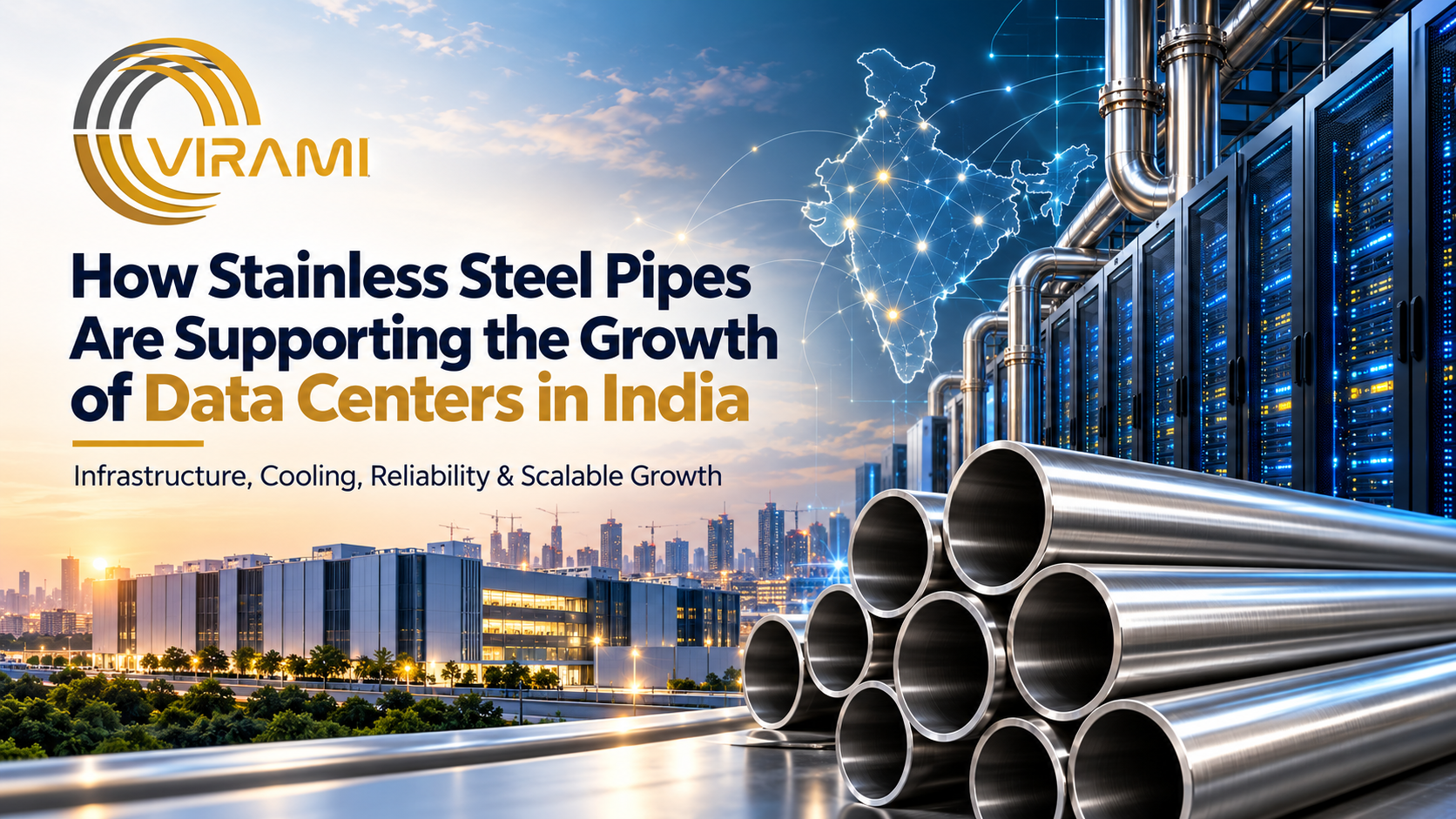
India’s digital infrastructure is expanding as cloud computing, artificial intelligence, online transactions, streaming, enterprise applications and other data-intensive services increase demand for computing capacity. Behind every server hall is a less visible layer of mechanical infrastructure that keeps equipment operating within safe limits. Stainless Steel Pipes can form part of that infrastructure where corrosion resistance, fluid compatibility, joint reliability and long service life are required.
Cooling-water loops, HVAC systems, fire-protection networks and utility lines must operate consistently because mechanical failures can affect facility availability. As India develops larger and denser data centers, piping decisions are increasingly connected to heat management, maintenance and lifecycle reliability.
India’s data-center expansion is being supported by wider cloud adoption, AI and high-performance computing, digital payments, enterprise digitalisation, growing internet consumption and hyperscale development.
India’s installed data-center capacity increased from about 375 MW in 2020 to around 1,500 MW by 2025, according to information published by IBEF citing the Press Information Bureau. The same source links this growth to cloud services, AI, digital platforms and high-performance computing.
Major capacity remains concentrated in established hubs. CBRE reported that Mumbai, Chennai, Delhi-NCR and Bengaluru together represented nearly 90% of operational capacity in September 2025, while Hyderabad also continues to attract data-center development.
A data center is not simply a building filled with servers. It is a mission-critical facility where cooling, power, fire safety and environmental control must work continuously within defined operating limits. Depending on facility design, piping may support:
Material selection cannot be standardised across all these services. Engineers must consider fluid chemistry, temperature, working pressure, corrosion risk, pipe dimensions, joining method, applicable codes, maintenance access and project specifications.
Stainless Steel Pipes are used in data-center infrastructure where the operating environment benefits from corrosion resistance, reliable fluid containment and durable piping. Their actual performance depends on the selected grade, system design, fabrication quality, installation and maintenance.
Cooling and utility systems may expose piping to treated water, oxygen, humidity, chemicals and changing conditions. Stainless steel develops a chromium-rich passive surface that helps resist corrosion in suitable environments. This can reduce concerns such as wall thinning, corrosion products and premature replacement.
Corrosion resistance is not absolute. Chlorides, temperature, stagnant conditions, treatment chemicals and contact with dissimilar metals can influence performance, so water chemistry and material compatibility require engineering review.
No pipe material is automatically leak-proof. System reliability also depends on pressure rating, welding or mechanical joints, supports, thermal movement, workmanship, testing and inspection.
Different stainless steel grades suit different environments. Water-service grades may fit some cooling duties, while heat-resistant or stabilised grades may be considered for specialised higher-temperature services.
In a conventional chilled-water arrangement, water circulates between cooling equipment and air-side cooling units through a closed piping network. Heat from the IT environment is transferred into the water loop and then rejected through chillers, cooling towers, dry coolers or another heat-rejection arrangement, depending on the facility design.
For chilled water piping, engineers may evaluate corrosion resistance, pressure capability, water chemistry, joint integrity, thermal expansion, insulation interfaces and maintenance accessibility.
AI and high-density computing are also influencing cooling strategies. Some facilities continue to use conventional air cooling supported by chilled water, while higher-density deployments may introduce direct-to-chip liquid cooling, coolant distribution units or other liquid-based heat-management systems.
Not every AI data center uses the same cooling architecture. However, as rack heat densities increase, dependable liquid cooling infrastructure, HVAC piping and cooling-water systems can become increasingly important.
Where Stainless Steel Pipes are specified, the decision should therefore be based on the complete data center cooling system, rather than corrosion resistance alone.
Data centers also depend on pipe networks for fire protection, service water and mechanical utilities. Stainless steel piping may be selected where corrosion exposure, cleanliness, durability or environmental conditions justify its use.
However, stainless steel is not mandatory for every fire-protection system. Fire piping must comply with the applicable code, approved system design, required pressure class, joining requirements and project specification.
Stainless Steel 310 Pipes are associated primarily with elevated-temperature service because the 310 family is known for good oxidation resistance and mechanical performance at high temperatures. Heat-resistant 310S variants are commonly positioned for high-temperature industrial applications.
SS 310 should not be treated as the standard choice for ordinary chilled-water piping.
Within data-center infrastructure, it may be considered for specialised services involving sustained heat or hot gases, potentially around selected exhaust, thermal or backup-power-related equipment, when temperature, pressure, corrosion conditions and project specifications justify the material.
The grade should therefore be selected because the service conditions require its high-temperature characteristics—not simply because it is a higher-alloy stainless steel.
Stainless Steel 321 Pipes use a titanium-stabilised austenitic stainless steel grade. Titanium stabilisation helps improve resistance to intergranular corrosion following exposure to elevated temperatures, making the grade useful in applications where welding or thermal exposure is a relevant consideration.
For data-center infrastructure, SS 321 should be viewed as an application-specific material rather than a universal cooling-water grade.
It may be considered for selected thermal, exhaust or mechanical services where elevated-temperature exposure and fabrication conditions make stabilisation beneficial.
| Consideration | Stainless Steel 310 | Stainless Steel 321 |
|---|---|---|
| Main characteristic | Elevated-temperature oxidation resistance | Titanium stabilisation and intergranular-corrosion resistance |
| Possible data-center relevance | Specialised hot or exhaust-related services | Specialised thermal or welded services |
| Ordinary chilled-water default? | No | No |
| Selection basis | Temperature, pressure, oxidation and environment | Temperature exposure, welding and corrosion conditions |
The right stainless steel pipe is selected by matching its material properties to the actual service conditions. Grade name, initial price or a general claim of corrosion resistance should not be the only procurement criteria.
Important factors include:
Project engineers, consultants and EPC contractors should confirm the required grade, dimensions, specification and testing requirements before procurement.
Stainless steel’s corrosion resistance and durability can support a long service life in appropriately specified applications. Longer-lasting piping may reduce the frequency of replacement and the material, labour and operational disruption associated with repeated repairs. Stainless steel is also recyclable after its useful service life.
However, Stainless Steel Pipes alone do not make a data center sustainable.
Overall environmental performance depends on factors such as energy sourcing, cooling efficiency, power utilisation, water management, heat rejection, equipment efficiency and operating practices. Efficient piping design can support cooling-system performance, but it remains one component of the complete facility.
As India adds cloud capacity, hyperscale facilities and AI-oriented computing infrastructure, mechanical systems will need to manage increasingly demanding heat loads and operational conditions.
This is likely to keep attention focused on cooling reliability, water management, corrosion control, liquid cooling infrastructure and maintainable piping layouts.
The role of stainless steel will remain application-specific. Data-center developers are unlikely to use one material everywhere. Instead, consultants and EPC contractors will compare lifecycle requirements, corrosion risk, operating temperature, joining methods, water chemistry and maintenance expectations before deciding where corrosion-resistant stainless steel piping systems offer practical value.
Virami Steel supplies stainless steel products for industrial requirements in India. For data-center developers, EPC contractors, consultants and procurement teams evaluating piping materials, the process should begin with a clear specification covering grade, dimensions, service conditions and applicable standards.
Buyers can review Virami Steel’s Stainless Steel Pipes range and discuss project-specific requirements according to the intended service.
For specialised requirements involving grades such as SS 310 or SS 321, the engineering team should first confirm whether the operating temperature, corrosion environment, fabrication conditions and system design actually require those material characteristics.
India’s data-center growth depends on far more than servers, processors and software. Reliable cooling, water circulation, fire safety and supporting mechanical systems are fundamental to continuous operation, and piping forms part of that physical foundation.
Stainless Steel Pipes can support selected data-center applications where corrosion resistance, dependable fluid handling and long service life justify their use. The correct solution depends on matching the grade and specification to water chemistry, temperature, pressure, installation conditions and applicable engineering requirements.
For project-specific stainless steel pipe requirements, data-center developers, consultants, EPC teams and procurement professionals can consult Virami Steel with their technical specifications before final material selection.
