
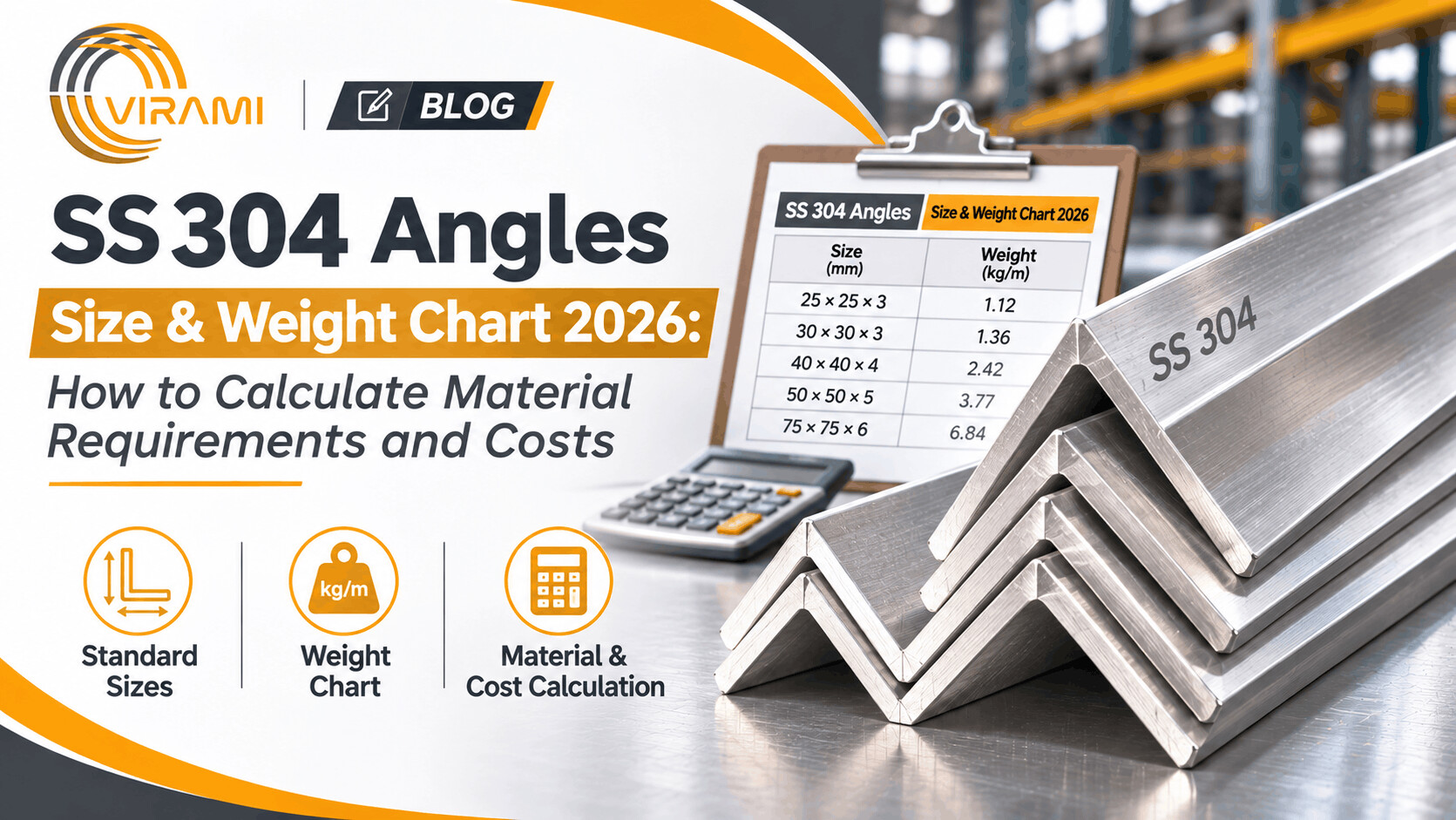
Ordering SS 304 angles for industrial fabrication requires checking leg dimensions, section weight, required stock lengths, and total material costs. Inaccurate calculations can cause excess stock, cutting waste, and purchase delays. A clear size and weight estimate helps buyers plan quantities accurately.
This 2026 SS 304 angles size and weight guide covers equal and unequal dimensions, theoretical weight formulas, cutting requirements, and cost estimates for procurement teams, fabricators, contractors, and engineers.
SS 304 Angles are L-shaped stainless steel sections used for supports, frames, brackets, equipment structures, and fabrication assemblies. Grade 304 (UNS S30400) is an austenitic chromium-nickel stainless steel valued for its general corrosion resistance, weldability, and formability. Its suitability still depends on the service environment, especially where chlorides or aggressive chemicals are present.
Angle dimensions are normally expressed as leg A × leg B × thickness, in millimetres. For example, 50 × 50 × 5 mm identifies two 50 mm legs with a nominal thickness of 5 mm. A buyer must also specify the required length, finish, tolerance, and applicable standard.
Equal angles have matching leg dimensions, such as 40 × 40 × 4 mm or 75 × 75 × 6 mm. They are frequently specified for frames, edge supports, and general fabrication.
Unequal angles have legs of different widths, such as 75 × 50 × 6 mm. They can be useful where the mounting face and projecting support have different dimensional requirements. Neither type should be selected for a load-bearing design solely by weight; an engineer must check loading, connections, buckling, and section properties.
The following reference chart uses a nominal SS 304 density of 7.93 g/cm³ (7,930 kg/m³). All weights are calculated from idealized sharp-corner L-sections and rounded to two decimal places.
| Equal angle size (mm) | Approx. kg/metre | Approx. kg/6-metre length |
|---|---|---|
| 20 × 20 × 3 | 0.88 | 5.28 |
| 25 × 25 × 3 | 1.12 | 6.71 |
| 30 × 30 × 3 | 1.36 | 8.14 |
| 40 × 40 × 4 | 2.41 | 14.46 |
| 40 × 40 × 5 | 2.97 | 17.84 |
| 50 × 50 × 5 | 3.77 | 22.60 |
| 50 × 50 × 6 | 4.47 | 26.84 |
| 60 × 60 × 6 | 5.42 | 32.54 |
| 65 × 65 × 6 | 5.90 | 35.40 |
| 75 × 75 × 6 | 6.85 | 41.11 |
| 75 × 75 × 8 | 9.01 | 54.05 |
| 90 × 90 × 8 | 10.91 | 65.47 |
| 100 × 100 × 8 | 12.18 | 73.08 |
| 100 × 100 × 10 | 15.07 | 90.40 |
| 150 × 150 × 12 | 27.41 | 164.44 |
Important: This is a calculation guide, not a confirmed stock list or certified mill weight table. Actual mass can differ because of internal radii, rounded corners, manufacturing tolerances, and finishing. Confirm available sizes and the supplier's billing-weight basis before ordering.
Unequal angle weights use the same density and theoretical method:
| Unequal angle size (mm) | Approx. kg/metre | Approx. kg/6-metre length |
|---|---|---|
| 40 × 25 × 4 | 1.93 | 11.61 |
| 50 × 30 × 5 | 2.97 | 17.84 |
| 60 × 40 × 5 | 3.77 | 22.60 |
| 75 × 50 × 6 | 5.66 | 33.97 |
| 100 × 65 × 7 | 8.77 | 52.62 |
| 100 × 75 × 8 | 10.59 | 63.57 |
These dimensions are illustrative reference sizes; availability, minimum orders, and lead times vary by supplier and manufacturing route.
Equal angle formula:
Weight (kg/m) = (2 × A − t) × t × 0.00793
Unequal angle formula:
Weight (kg/m) = (A + B − t) × t × 0.00793
Here, A and B represent leg dimensions in millimetres, and t represents thickness in millimetres. The factor 0.00793 converts the calculated cross-sectional area into kilograms per metre using SS 304's nominal density.
Example: 50 × 50 × 5 mm equal angle
This formula excludes the real angle's corner radii, so use the mill's section weight where exact quantities, engineered loads, or payment terms require it.
Material planning starts with a cutting list rather than a simple sum of finished-piece lengths. Record every required section size, cut length, quantity, and permitted tolerance. Group identical sizes together, then calculate how many finished pieces can be cut from each purchasable stock length.
Consider a project requiring 96 pieces of 50 × 50 × 5 mm SS 304 angle, each 1.1 metres long. If the offered stock length is 6 metres, five pieces fit into each bar, with space remaining for ordinary saw cuts.
The 14.4-metre difference represents unused stock length before accounting for cutting kerf. Some offcuts may be reusable. Cut optimization, minimum acceptable remnant lengths, and supplier cutting services can materially change purchasing economics.
For a weight-based quotation, multiply the agreed chargeable weight by the quoted price per kilogram:
Estimated material cost = Chargeable weight (kg) × Quoted rate (₹/kg)
Using the 452.01 kg example above and a purely illustrative rate of ₹250/kg, the estimated base material value is ₹113,002.50. This rate is a calculation example, not a verified November 2026 market quotation. Request a current, grade-specific price before preparing a purchase order.
Additional charges may include cut-to-length processing, polishing, testing, packing, freight, and applicable taxes. A lower per-kilogram rate may not be cheaper if it involves higher cutting losses or extra finishing. Check whether the supplier invoices on theoretical weight, actual measured weight, or a fixed per-piece basis.
Angle dimensions and thickness. Heavier sections increase kilograms per running metre. Check the approved drawing before substituting a thicker angle.
Grade and material certification. Confirm SS 304 rather than 304L or another grade where the project specifies an exact material. Request a mill test certificate when traceability matters.
Finish and processing. As-rolled, pickled, or polished finishes can involve different processing costs. Do not pay for an appearance requirement your application does not need.
Stock length and cutting yield. Standard bars can create costly remnants. A supplier's cutting plan may reduce total material ordered, even when a service charge applies.
Quantity, transport, and delivery. Order volume, packing method, project location, and delivery schedule affect the landed price and procurement risk.
SS 304 angles are used in equipment frames, support brackets, conveyor structures, machine guards, shelving, architectural fabrication, and non-critical mounting assemblies. Their corrosion resistance and ease of fabrication make them useful in many indoor industrial environments.
For food-processing and pharmaceutical projects, assess cleanability, surface finish, and weld treatment. In coastal or chloride-rich conditions, evaluate whether SS 316 or another alloy is more appropriate. For structural or safety-critical uses, obtain engineering approval of section sizes and connections rather than relying on a weight chart alone.
For SS 304 Angles, contact Virami Steel with your leg dimensions, thickness, required lengths, quantity, finish, and certification needs. Include a cutting list for multiple finished lengths. Request confirmation of stock availability, material grade, weight basis, processing options, lead time, and delivered pricing so quotations reflect the actual fabrication requirements.
Its approximate theoretical weight is 3.77 kg per metre, or 22.60 kg for 6 metres, using a density of 7.93 g/cm³ and an idealized L-section formula.
Multiply the theoretical weight per metre by the ordered length and quantity. Allow separately for dimensional variations, cutting waste, and any differences in invoicing weight.
Both methods are possible. Ask for the quoted unit, applicable minimum order, stock length, and whether invoicing uses calculated or actual weight.
No. It provides reference calculations, not live stock data. Verify specific dimensions, lengths, finish, and delivery dates before purchasing.
The SS 304 angles size and weight chart supports material planning, but procurement also requires reviewing cutting yield, grade, finishes, certification, and delivered costs. Use the formulas to estimate quantities, then request a supplier-confirmed quotation against your cutting list to reduce waste, control costs, and avoid delays.
