
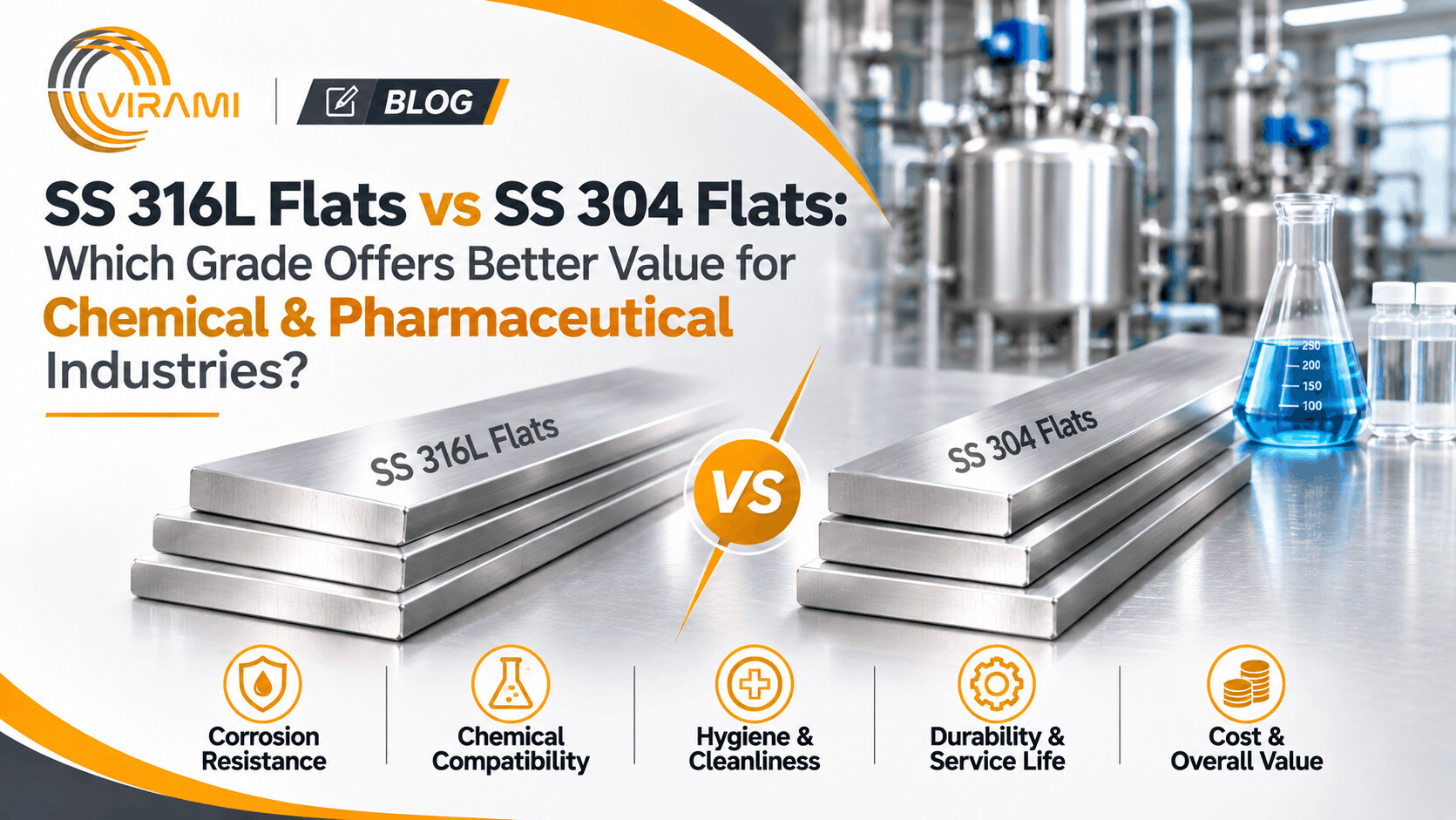
Chemical processors, pharmaceutical manufacturers, and industrial equipment fabricators often compare SS 304 flats with SS 316L flats. Both offer corrosion resistance, durability, and fabrication flexibility, but their suitability depends on operating conditions.
SS 304 is generally more economical for mild environments, while SS 316L offers improved resistance to chloride-related corrosion and advantages for certain welded applications.
SS 304 flats are rectangular stainless steel sections manufactured using a chromium-nickel austenitic alloy. They are commonly used for machinery frames, support brackets, equipment structures, and general industrial fabrication.
SS 304 resists corrosion in mild environments and offers good workability at relatively lower cost.
SS 316L Flats are manufactured using a molybdenum-bearing austenitic stainless steel with a low carbon content. The addition of molybdenum improves resistance to pitting and crevice corrosion in many chloride-containing environments.
The low carbon content reduces the risk of sensitization during welding, making SS 316L useful for fabricated equipment where corrosion resistance around welded areas is important.
However, neither grade is suitable for every chemical environment.
| Property | SS 304 Flats | SS 316L Flats |
|---|---|---|
| UNS designation | S30400 | S31603 |
| Chromium | 18–20% | 16–18% |
| Nickel | 8–10.5% | 10–14% |
| Molybdenum | No intentional addition | 2–3% |
| Maximum carbon | 0.08% | 0.03% |
| Corrosion resistance | Good in mild environments | Improved in many chloride environments |
| Weldability | Good | Good, with reduced sensitization risk |
| Surface finishing | Polishing and other finishing possible | Polishing and other finishing possible |
| Relative material cost | Generally lower | Generally higher |
| Typical applications | Equipment frames, brackets, general fabrication | Chemical equipment, pharmaceutical components, chloride-exposed assemblies |
Chemical composition ranges are representative of common ASTM specifications. Confirm the applicable standard and mill test certificate for actual material acceptance.
SS 304 performs well in many indoor industrial environments, particularly where equipment is exposed to ordinary atmospheric moisture and compatible processing materials.
Common applications include machinery supports, equipment platforms, mounting brackets, and external structural components.
However, chloride-rich cleaning solutions, concentrated salts, and certain aggressive chemicals can cause localized corrosion.
SS 316L contains molybdenum, which improves its resistance to pitting and crevice corrosion in many chloride-containing environments.
This makes it a useful option for components exposed to selected process chemicals, washdown conditions, or environments where SS 304 may experience premature corrosion.
Importantly, SS 316L is not corrosion-proof. Hot concentrated chlorides, hydrochloric acid, and certain other aggressive media may require more corrosion-resistant alloys.
Buying recommendation: Check chemical concentration, temperature, exposure duration, and cleaning procedures before selecting a grade.
Chemical processing facilities frequently handle multiple substances, including solvents, cleaning agents, acids, and process liquids.
SS 304 flats may be considered for:
SS 316L flats may be considered for:
SS 316L may prevent premature replacement in corrosive service conditions, but unnecessary upgrades increase procurement costs.
For chemical processing plants, obtaining corrosion-compatibility guidance from qualified engineers is essential.
Pharmaceutical manufacturing requires careful consideration of material compatibility, cleaning procedures, surface finish, and contamination control.
SS 304 flats can be suitable for external equipment frames, secondary structural components, storage supports, and selected non-product-contact assemblies.
For these applications, the lower material cost may offer an economic advantage when exposure conditions are compatible.
SS 316L is frequently specified for pharmaceutical processing components where chemical compatibility, corrosion resistance, and welded construction are important.
Potential applications include certain equipment supports, fabricated processing assemblies, and components associated with hygienic equipment.
However, the grade alone does not ensure pharmaceutical compliance.
Product-contact surfaces may require specific roughness limits, hygienic welding, appropriate polishing, passivation, cleaning validation, and documented material traceability.
For pharmaceutical procurement, follow the approved equipment specification instead of automatically selecting SS 316L.
Both SS 304 and SS 316L offer good fabrication characteristics and can be cut, drilled, formed, machined, and welded using suitable methods.
Standard SS 304 contains a higher permitted carbon level than SS 316L. Under certain thermal conditions, chromium carbide precipitation can increase susceptibility to intergranular corrosion.
SS 316L's lower carbon content reduces this risk, making it attractive for welded equipment exposed to corrosive conditions.
However, SS 304L also offers low-carbon benefits and should be considered when SS 316L's molybdenum addition is unnecessary.
A higher SS 316L price does not guarantee greater strength; verify specification, processing condition, and material properties from the mill test certificate.
For load-bearing parts, verify approved design calculations and material test results.
Surface finish influences the cleanability, appearance, and corrosion performance of stainless steel components.
SS 304 and SS 316L flats may be supplied in hot-finished, cold-finished, ground, or polished conditions, subject to manufacturing and supplier availability.
For general industrial brackets, additional polishing may not be necessary.
A smooth, properly finished surface can reduce residue retention and simplify cleaning. Electropolishing may be specified for certain hygienic applications.
Nevertheless, neither polishing nor electropolishing can compensate for choosing an alloy incompatible with the process chemical.
Buyers should specify finish, edge condition, dimensional tolerance, and applicable surface roughness requirements.
SS 304 generally has a lower purchase price because SS 316L contains additional alloying elements, particularly molybdenum and typically more nickel.
Consider the following purchasing factors:
| Cost Factor | What Buyers Should Evaluate |
|---|---|
| Material price | Quoted rate per kilogram |
| Fabrication | Cutting, welding, machining and finishing |
| Maintenance | Cleaning, inspection and corrosion-related repairs |
| Replacement | Expected component service life |
| Downtime | Potential production interruption |
| Documentation | Testing, certificates and traceability |
In mild environments, upgrading a reliable SS 304 component to SS 316L may offer limited savings.
Conversely, where corrosion causes frequent component replacement, paying more for a suitable corrosion-resistant grade may reduce overall lifecycle costs.
Supplier selection matters because incorrect grades, dimensions, or documentation can delay fabrication and create costly rework.
Before placing an order, verify the following:
When approaching Virami Steel, buyers can share their required grade, dimensions, quantities, application details, and material documentation requirements.
Request confirmation of the available product specifications, delivery condition, processing options, and current pricing before placing an order.
SS 316L generally offers improved resistance to pitting and crevice corrosion in many chloride-containing environments. However, SS 304 may be more economical for compatible mild operating conditions. The actual chemicals and temperatures determine suitability.
SS 316L combines good corrosion resistance with low-carbon welding characteristics. It is commonly considered for selected pharmaceutical equipment components, although surface finish, hygienic design, and documentation are also essential.
Generally, yes. SS 316L typically costs more because of its alloy composition. Actual prices depend on dimensions, quantity, finishing requirements, market conditions, and supplier quotations.
Yes. SS 304 flats can be suitable for equipment frames, supports, and selected non-product-contact applications where operating conditions permit. Product-contact requirements should follow approved specifications.
Confirm the material standard, grade, dimensions, surface finish, quantity, certificates, and delivery requirements. Buyers can approach Virami Steel with these details to request a specification-based quotation.
SS 304 flats suit economical general fabrication in moderate environments. SS 316L flats can offer better value when chloride resistance or low-carbon welded construction is required.
For chemical and pharmaceutical industries, the best selection depends on operating conditions, fabrication requirements, maintenance expectations, and total lifecycle cost.
Choosing the correct grade and requesting accurate supplier documentation can help reduce procurement risks while supporting reliable industrial equipment performance.
