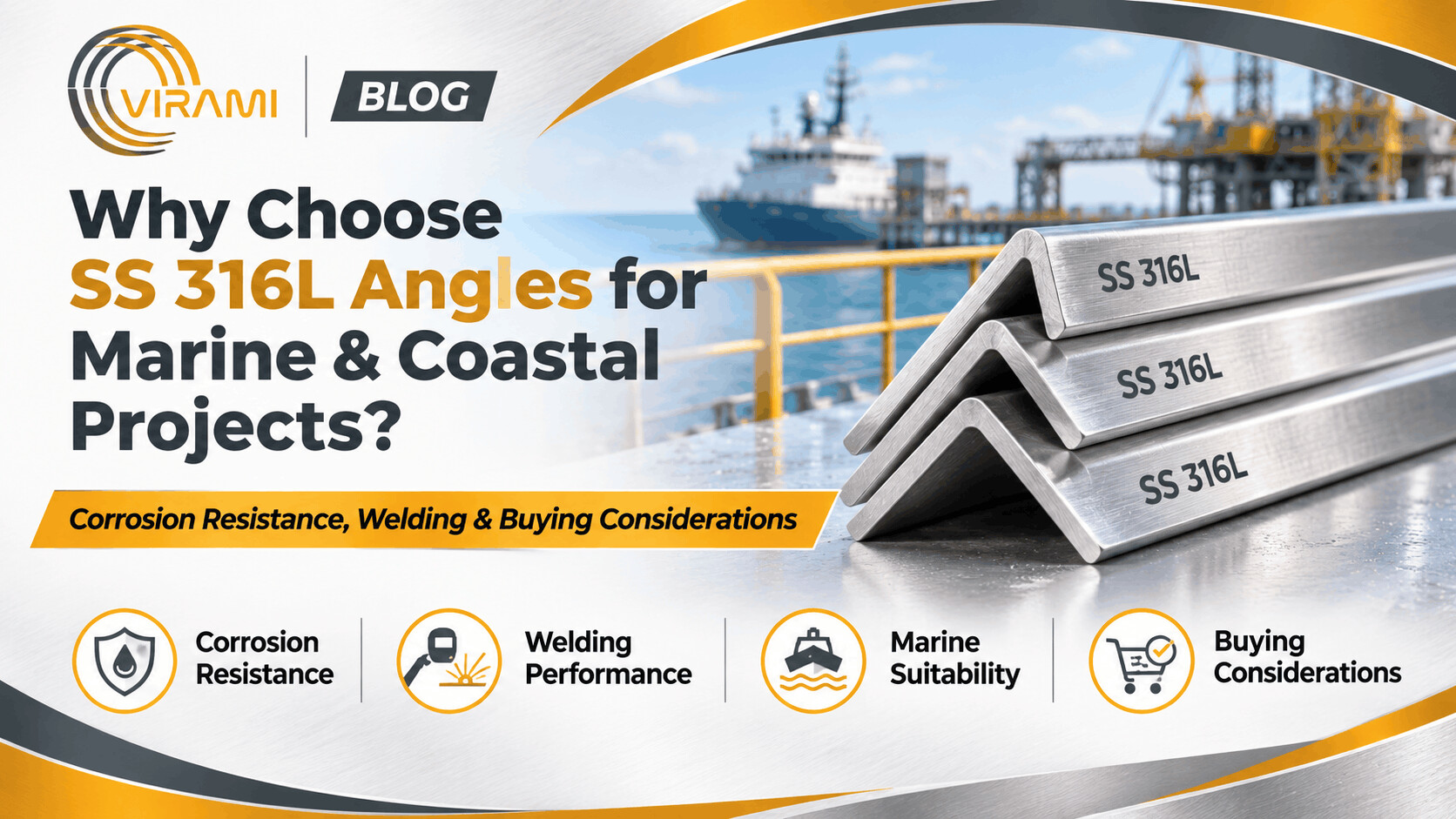
Coastal fabrication projects expose metal components to salt-laden air, humidity, rainfall and, in some locations, direct seawater spray. An unsuitable section can develop staining, connection corrosion and premature maintenance costs. SS 316L angles are frequently considered for marine-facing structures because their alloy composition offers improved chloride resistance compared with common SS 304.
However, “marine grade” does not mean corrosion-proof. Buying decisions depend on exposure, welding, dimensions and maintenance. This guide explains performance, limitations and buying requirements.
SS 316L Angles are L-shaped sections made from low-carbon, molybdenum-bearing austenitic stainless steel. Equal and unequal legs suit different mounting and structural requirements.
The grade is designated UNS S31603. Its typical specification includes 16–18% chromium, 10–14% nickel, 2–3% molybdenum and a maximum carbon content of 0.03%, subject to the governing material standard. Molybdenum improves resistance to localized corrosion, while the low carbon level reduces the likelihood of sensitization during welding.
Common uses include supports, brackets, frames and architectural components.
Chlorides from sea spray can settle on exposed steel and become concentrated as moisture evaporates. In sheltered locations, salt deposits may remain longer because rainfall cannot wash them away.
SS 316L relies on a protective chromium-rich passive film, as other stainless steels do. Its molybdenum content improves resistance to chloride-induced pitting compared with SS 304, making it a useful starting choice for many coastal atmospheric applications.
Two corrosion mechanisms deserve particular attention:
Material grade alone cannot eliminate either risk. Drainage, inspection and cleaning remain important.
| Selection Factor | SS 304 Angles | SS 316L Angles |
|---|---|---|
| Molybdenum | No intentional addition | Typically 2–3% |
| Carbon limit | Typically 0.08% maximum | 0.03% maximum |
| Chloride exposure | Less resistant to pitting | Improved pitting resistance |
| Welded construction | Weldable; sensitization depends on conditions | Low-carbon composition limits sensitization risk |
| Typical purchase cost | Generally lower | Generally higher |
| Best consideration | Mild, well-controlled environments | Many coastal atmospheric applications |
The higher initial cost can be justified by reduced maintenance, but suitability depends on the site.
This distinction is essential for buyers. SS 316L is often appropriate for certain coastal atmospheres, but prolonged seawater contact is substantially more aggressive than exposure to salty air.
Warm, stagnant seawater, deposits and tight crevices can initiate localized corrosion even in 316L. Constant immersion or severe splash-zone exposure may require duplex, superduplex or higher-molybdenum stainless steels following a corrosion assessment.
Before choosing the grade, establish whether the angle will experience airborne salt, occasional spray, repeated wetting, tidal exposure or permanent immersion. Temperature, water flow and cleaning access can change the material recommendation.
Avoid describing 316L as rust-proof or suitable for all seawater conditions in purchase specifications.
Weldability is a practical benefit of SS 316L. Its low carbon content helps reduce chromium-carbide sensitization associated with certain welding thermal cycles, which is valuable where welded joints will face corrosive exposure.
Still, a suitable grade cannot compensate for poor welding practice. Fabricators should use approved procedures, appropriate consumables, controlled heat input and adequate shielding. For many matching 316L welds, an appropriate 316L-class filler may be selected according to the procedure and design requirements.
Post-weld condition matters just as much. Visible heat tint indicates altered surface oxide and can reduce local corrosion resistance. Specify suitable weld cleaning and, where required, pickling or passivation. Keep stainless components separate from carbon-steel grinding dust and shared contaminated tools.
Inspect joints for incomplete welds and moisture-trapping crevices before installation.
An angle section can hold moisture where its legs meet adjacent surfaces. Horizontal ledges, overlapping members and concealed bolted joints may accumulate salt. Consider drainage, joint access and cleaning requirements at the design stage.
A smoother, clean surface generally makes salt removal easier. Buyers should specify the required finish instead of assuming all bright or polished material has identical corrosion performance. Edge condition, weld dressing and removal of embedded iron contamination also matter.
Avoid dissimilar-metal combinations without reviewing galvanic-corrosion risk, especially when a common electrolyte such as saltwater can bridge connected metals.
Regular fresh-water cleaning may reduce accumulated salt, but maintenance frequency should reflect the actual exposure and installed geometry.
For procurement, an angle description must include leg A × leg B × thickness × length. Equal and unequal sections should never be treated as interchangeable without design approval.
Check these details before ordering:
An approximate theoretical equal-angle weight may be estimated from (2A − t) × t × 0.00798 kg/m, with dimensions in millimetres. This assumes a sharp-corner section and nominal 316L density of 7.98 g/cm³. Actual section weights depend on radii and manufacturing tolerances.
SS 316L normally carries a premium over SS 304 because of its alloy content. However, a purchasing decision should include fabrication costs, maintenance access, expected replacement intervals and possible downtime.
For example, an exposed bracket that is difficult to replace may justify a more corrosion-resistant specification. Conversely, an indoor fitting protected from salt exposure may not benefit economically from the upgrade.
Request comparable quotations with the same dimensions, finish, certificate requirements and delivery terms. A low per-kilogram quote can become expensive if it excludes cutting, finishing, transport or required inspection.
When enquiring about SS 316L Angles, share the drawing, exposure description, quantities, finish and documentation needs. Mention whether the component faces open coastal air, direct spray or seawater contact so the proposed specification can be reviewed.
Contact Virami Steel for a quotation based on your project requirements. Confirm available sizes, material certificates, processing options, delivery schedule and applicable charges before issuing a purchase order.
No. They offer improved chloride resistance compared with SS 304 but can still suffer pitting or crevice corrosion, particularly in stagnant or continuously immersed conditions.
Its low carbon content reduces sensitization risk during welding. Appropriate filler selection, surface cleaning and corrosion-conscious joint design are still necessary.
They are commonly considered for coastal atmospheric applications, but performance depends on exposure severity, finish, design and maintenance. Severe splash or immersion may require another grade.
Provide the grade, leg dimensions, thickness, length, quantity, finish, application, required standards, certificates and delivery location.
Often it can be, when its higher corrosion resistance reduces maintenance and replacement risk. Compare the total installed and operating cost, not simply the material price.
SS 316L angles offer a useful balance of corrosion resistance, fabrication flexibility and weldability for many marine-adjacent and coastal projects. Their value is greatest when the alloy matches the environment and the design avoids trapped saltwater and poorly finished joints.
For a reliable purchase, confirm exposure, approved dimensions, surface condition, certification and delivered cost. Where direct seawater immersion or severe conditions are expected, obtain specialist material-selection advice before ordering.
